The best med spa no-show policy asks for a card on file, not money up front. It cuts consult no-shows without scaring people off. The patient picks a time, saves a card and pays nothing today. You charge a set fee only if they skip or cancel late. Word the policy kindly, send three reminders and track who shows up.
A no-show is a booked consult where the person never arrives and never calls. Each one leaves an empty slot your provider still has to staff. No-shows are common. Across 105 studies of health care visits in general, not med spas, the average no-show rate was about 23% (Health Policy, 2018).
Should a med spa take a deposit or a card on file?
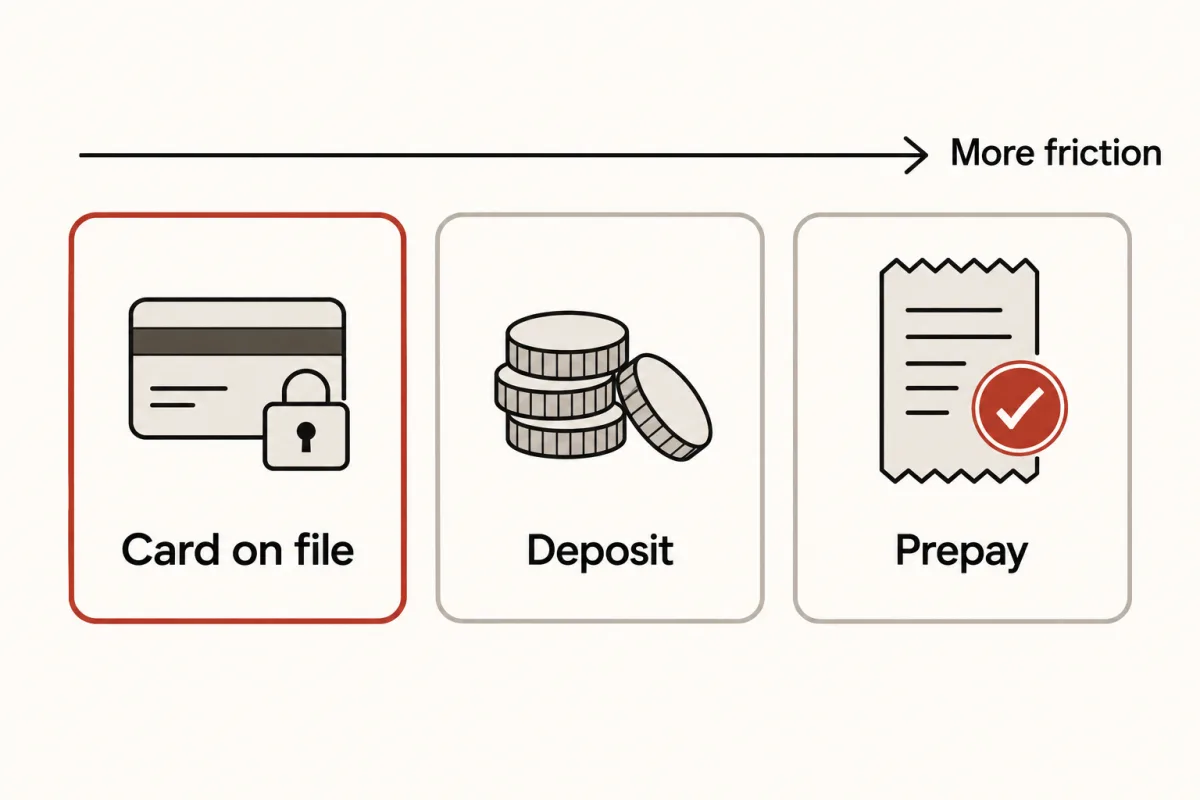
For a free or low-price consult, take a card on file. The patient saves a card in your booking or payment system and nothing is charged. It gives the patient a stake (something to lose if they skip) without asking a stranger to pay first. A deposit (a set amount paid now, taken off the bill) or full prepay fits a long or costly visit. The table compares all three.
| Compare | Card on file | Deposit | Prepay |
|---|---|---|---|
| At booking | Card saved, nothing charged | A set amount charged | Full price charged |
| What the patient feels | "I am holding my spot" | "I have put money down" | "I have bought this" |
| What you can charge later | The fee in the policy, after a miss or late cancel | The deposit, per the policy | The payment, or turn it into credit |
| Friction for a stranger | Low: one extra step | Medium: money moves before they meet you | High: a full yes before they meet you |
| Best fit | Free or low-price consults | Long or high-value visits | A fixed-price first treatment |
Tell your team and your patients the same thing: a card on file is a hold, not a fee. Nobody pays to book.
Why do people skip a consult they booked?
People skip for three plain reasons. Picture a made-up patient. She taps a filler ad at 10pm and books Thursday at 4pm in the DM, with no card. On Thursday she forgets. Nobody can fill a 4pm slot at 3:55.
- No stake. A free booking costs nothing to break. A saved card changes that without a charge.
- No reminder. A booking made days ago fades. Reminders bring it back. In the same review, a long wait between booking and the visit was one of the factors most often linked to no-shows (Health Policy, 2018).
- Booked on impulse. A late-night tap is a soft yes. A short card step makes it firmer.
Fix all three with a card step and reminders.
How should a med spa no show policy be worded?
Use three short sentences in this order: nothing is charged today, how to change the time for free, and what a miss costs.
- "We hold your consult with a card on file. Nothing is charged today."
- "Need a new time? Tell us at least 24 hours before and there is no fee."
- "If you miss the visit or cancel with less than 24 hours' notice, we charge a $50 fee to this card."
The $50 is an example, not a standard price. Order matters: the patient reads "nothing is charged today" and the free way out before the cost. Vague words like "a fee may apply" make people nervous.
Before you publish it, check these points:
- The fee in dollars.
- The window in hours, such as 24 or 48.
- How to cancel, such as replying to the text or the DM.
- Where it shows: at booking, in the confirmation and in each reminder.
- Consent: a checkbox or a "Yes" reply before the card is saved. Keep that record.
Fee rules vary by state. Have your payment processor (the company that runs your card payments) and attorney check the wording.
Where to ask for the card in a DM or online booking
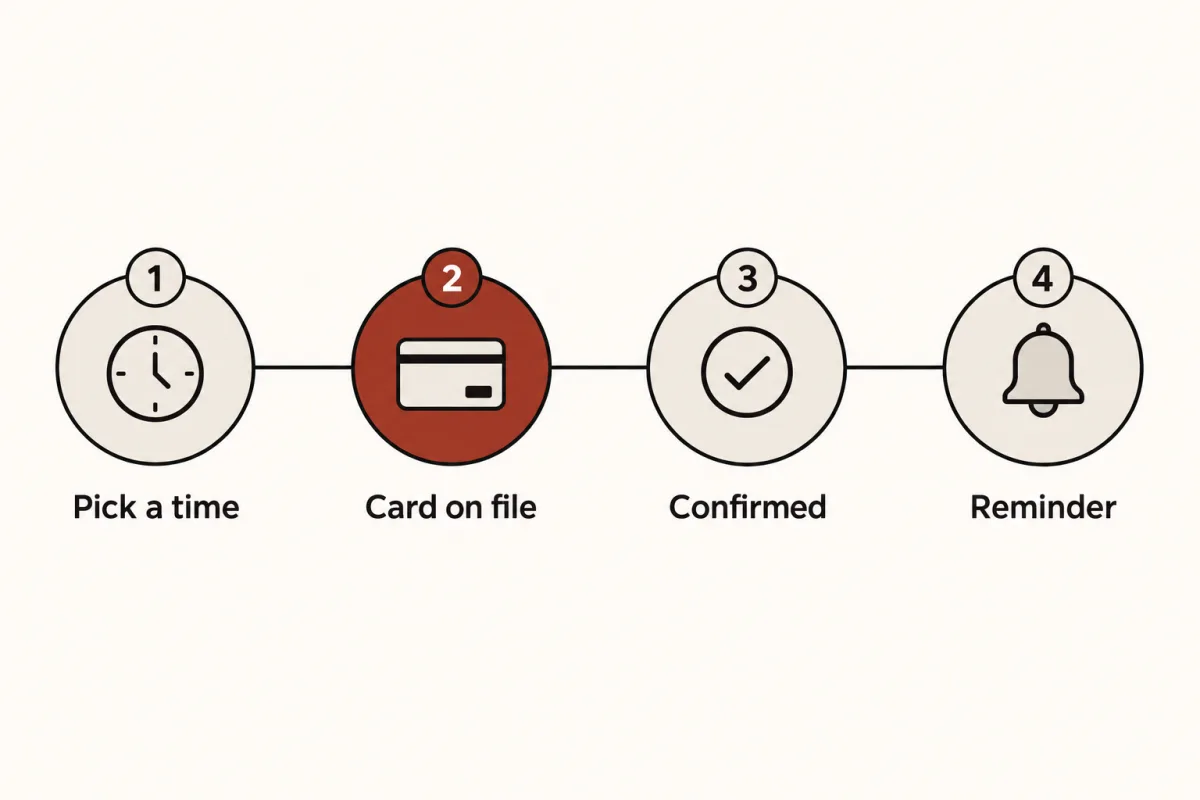
Ask for the card after the patient picks a time and before you confirm. They have already said yes to a time. So the card feels like saving their spot, not a price to get in.
- Answer their questions about the offer.
- Ask non-clinical qualifying questions (simple checks that they fit the offer), such as which area they want to discuss.
- Offer two or three open times.
- Once they pick one, show the three-sentence policy and send a secure card link.
- When the card is saved, confirm the date, time, address and the 24-hour rule.
- Write the consult into your booking system.
Never ask anyone to type a card number into a DM. Send a secure link. The same order applies if an AI handles the chat. Our guide to an AI receptionist for med spas covers what to check before software takes cards for you.
Which reminders work with a card on file?
Send three messages: a confirmation right away, a reminder 48 hours before and a short note on the day. Each one restates the time and gives an easy way to reschedule. Text reminders help. In one review of health care appointments, 78.6% of patients who got text reminders showed up, compared with 67.8% with no reminder (Cochrane, 2013).
- Right after booking: date, time, address and the policy.
- 48 hours before: "See you Thursday at 4pm. Need a new time? Reply before Wednesday at 4pm and there is no fee." You get the slot back early enough to refill it.
- Morning of the visit: time and parking.
A reminder sent after the free window closes feels like a trap. Send the 48-hour one before then. Get written consent before you text.
How to handle cancellations, reschedules and refunds
Make the free path easy and the fee rare. The card exists to fill the chair, not to collect fees.
- Cancel inside the window: no fee. Offer two new times in the same reply.
- Late cancel or no-show: send a kind message first and offer to rebook. Then charge the fee the policy states, and say so.
- Emergencies: let one named manager waive the fee, and log why.
- Refunds: if the clinic cancels or a fee was charged by mistake, refund it in full the same day.
Write each case down so the front desk applies it the same way every time.
What to measure after you add a card on file policy
Track five numbers weekly. The last one shows whether the policy scares people off.
- Booked consults: a date and time chosen with a card saved.
- Attended consults: people who walked in.
- Late cancels: cancels inside the fee window.
- No-shows: booked, not cancelled, did not arrive.
- Card drop-off: people who picked a time but stopped at the card step.
Hypothetical example: 40 people pick a time and 32 save a card. Of those 32, 2 cancel late and 4 do not show, so 26 attend (about 81%). Card drop-off is 8 out of 40, or 20%. Compare attended consults with the weeks before the card, using the same offer.
If drop-off is high, fix the wording before you drop the card. Lots of fees means weak reminders. Fix those first. Our guide to tracking med spa marketing ROI (return on investment) turns these counts into cost per attended consult.
How Ryder Scale uses a card on file
At Ryder Scale, a card on file is part of how we define a booking. A clinic pays us for each qualified booked consult. That means a date and time chosen with a card on file. It is not a promise that the person attends, buys or is clinically suitable.
We run Instagram and Facebook ads for one front-end offer per clinic (the first thing a new patient books). The ad opens a DM. Our AI receptionist replies only to those DMs. It answers questions about the offer, asks non-clinical qualifying questions, offers times and takes a card on file. Then it writes the consult into your booking system (Boulevard, Zenoti, Vagaro, Mindbody, Aesthetic Record or Square). Anything else goes to your team. Clinical decisions stay with your professionals. Our comparison of pay per lead vs pay per booked consult explains why we bill on the booking. Ryder Scale is not affiliated with Meta.
Frequently asked questions
Is a card on file the same as a consultation deposit?
No. A deposit charges a set amount at booking and comes off the bill later. A card on file charges nothing at booking. The clinic charges the stated fee only if the patient misses the visit or cancels inside the window they agreed to.
Will asking for a card scare new patients away?
Some people will stop at the card step, so count them. Some of them would never have shown up. You cannot tell which ones. Judge the policy on attended consults, not bookings alone. Keep drop-off low by asking after they pick a time and saying "nothing is charged today" before you mention any fee.
How much should a med spa no-show fee be?
It depends on what an empty slot costs you: the consult length, your provider's time and the offer price. The fee should cover part of the lost time without feeling like a penalty. Pick one dollar amount, show it before the card is saved and use it for every new patient.
Can I charge a no-show fee if the patient never agreed to it?
No. Charge only a fee the patient saw and agreed to before the card was saved. Show the policy in the booking flow, get a checkbox or a "Yes" reply, and keep the record. Without it, a bank dispute (a chargeback) is hard to win. Ask your payment processor and attorney what proof they require.
For the messages that lead up to the card step, see our med spa DM scripts. Ryder Scale has no retainer and no setup fee. You pay only per qualified booked consult. Book a free 20-minute audit at ryderscale.com to see whether it fits your clinic.