
Here is how to track ROI for med spa marketing: connect what you spend to the patients it brings in. ROI means return on investment. Next, look at what remains after service delivery costs. Keep each step visible: inquiry, booked consult, attended consult and paying patient. Then divide total marketing cost by the count at each step.
To run your own numbers, use our free med spa marketing cost calculator. It shows your cost per lead, per booked consult and per new patient.
Cost per lead is useful for diagnosing an ad campaign. It cannot tell you whether the campaign is profitable on its own.
Give every stage a clear definition
Use the same definitions in the ad report, booking system and agency invoice.
| Stage | What to count |
|---|---|
| Inquiry | One distinct person expressing interest through the campaign. Count repeat messages and form submissions from the same person once. |
| Booked consult | A confirmed date and time. Record any additional requirement in your booking definition. |
| Attended consult | A consult the person actually attended, not a calendar reservation. |
| New paying patient | A new patient who purchased, with collected revenue recorded separately from quoted treatment value. |
For Ryder Scale, a qualified booked consult includes a date and time chosen with a card on file. Do not treat that as an attended appointment or a clinical assessment. Keep those later outcomes separate. If a provider bills per lead or per booked consult, read our comparison of pay per lead and pay per booked consult. It shows what each definition changes about the invoice.
Calculate the costs that answer different questions
For a defined campaign cohort (one group of people who first inquired from the same campaign in the same period), use:
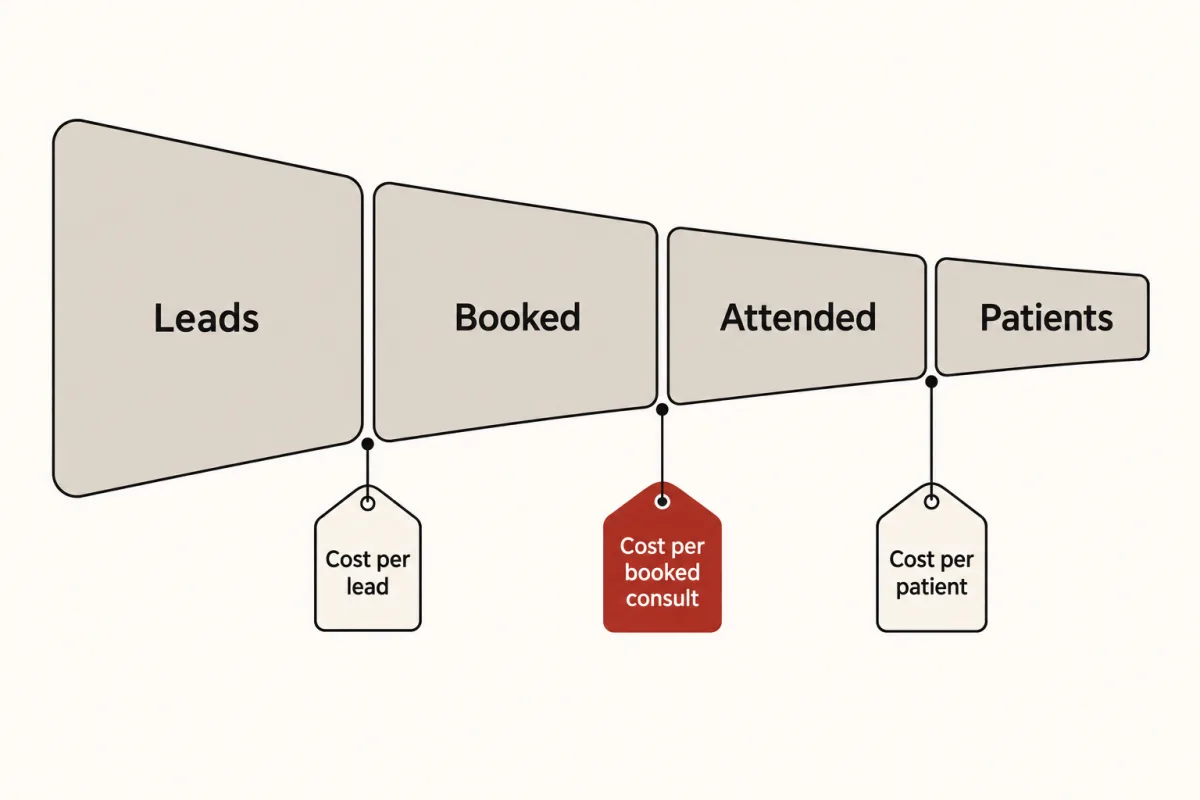
- Media cost per inquiry: ad spend divided by unique inquiries.
- All-in cost per booked consult: attributable marketing cost divided by booked consults.
- All-in cost per attended consult: attributable marketing cost divided by attended consults.
- Customer acquisition cost: attributable marketing cost divided by new paying patients.
Attributable marketing cost can include media, creative, agency work, software and follow-up resources. Choose a consistent allocation method, document it and avoid counting the same cost twice. Show both media-only and all-in numbers if you need them, and label them clearly.
How to track ROI for med spa marketing: a worked example
The following numbers are a hypothetical example, not a benchmark. They are not Ryder Scale client results, a fee quote or a prediction for your clinic.
Suppose a campaign cohort costs $2,400 in total, including $1,600 of media spend and $800 of allocated marketing costs. It produces 80 unique inquiries, 24 booked consults, 18 attended consults and 12 new paying patients.
| Metric | Calculation | Result |
|---|---|---|
| Media cost per inquiry | $1,600 / 80 | $20 |
| All-in cost per booked consult | $2,400 / 24 | $100 |
| All-in cost per attended consult | $2,400 / 18 | $133.33 |
| Customer acquisition cost | $2,400 / 12 | $200 |
If the patients generate $6,000 in collected revenue, the revenue-to-marketing-cost ratio is 2.5. That is not a profit calculation. Suppose the same revenue produces $3,600 after the variable costs of delivering those services, but before marketing and fixed overhead. After subtracting the $2,400 marketing cost, $1,200 remains toward overhead and profit.
Using that definition, which is based on what is left after service delivery costs, marketing ROI is ($3,600 - $2,400) / $2,400, or 50%. Fixed overhead, taxes and the reliability of attribution (deciding which ad or channel gets credit for a patient) still matter. The lesson is to name what you divide and what you divide by, not call every revenue multiple "ROI."
Keep the reporting window consistent
A person who inquires late in the month may attend next month. Comparing this month's spend with this month's appointments can mix different groups of people.
Keep an acquisition cohort, such as inquiries first received from a specific campaign during September. Update that cohort as people book, attend and purchase. Also keep a calendar view for day-to-day capacity, but do not confuse the two views.
For each record, retain the source or campaign identifier, inquiry date, booking status, attendance and purchase outcome in an appropriate system. Treat unknown sources as unknown rather than assigning them to the channel you want to look successful.
Treat attribution as evidence, not certainty
Someone may see an Instagram ad, search for the clinic later and then book. The ad platform, website analytics and booking system can credit that journey differently. That search step is common. 59% of US adults said doctor rating sites were somewhat or very important when choosing a doctor (JAMA, 2014).
Use documented source tracking and reconcile it with the booking records. Ask new patients how they heard about you as an additional signal, not a perfect replacement. Where feasible, use a suitable controlled test to measure incremental results (the bookings that happened only because the ad ran). A campaign-attributed booking is not proof that the booking would never have happened otherwise.
Keep patient information in appropriate systems. Do not send diagnoses, treatment histories or private message text into general marketing analytics to make a report more detailed.
Use the report to choose the next action
- Few inquiries: inspect the offer, creative, audience and destination.
- Inquiries but few bookings: inspect the actual conversations, response coverage, price clarity and scheduling friction.
- Bookings but few arrivals: check confirmations, rescheduling and the clinic's booking process. In one review of health care visits, 78.6% of patients who got text reminders showed up, compared with 67.8% with no reminder (Cochrane, 2013).
- Attendance but few purchases: review offer fit and the consultation process with the clinic. More ad spend does not automatically fix this stage.
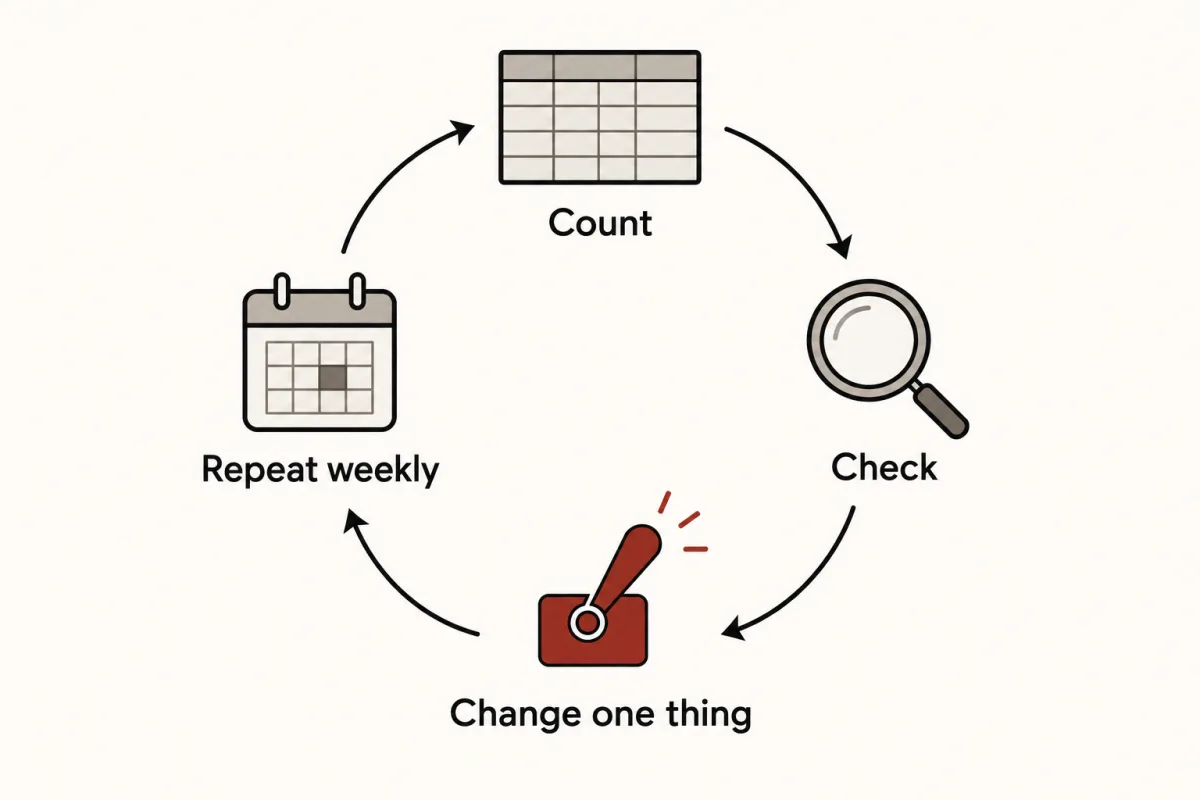
These are starting points for investigation, not diagnoses based on one ratio. Compare like-for-like offers and give each cohort enough time to progress before drawing conclusions.
What to ask your marketing provider for
Ask for spend, unique inquiries, bookings, attendance and paying patients, with definitions and the date range attached. If its scope ends at the booked consult, agree on how your clinic will supply the later outcomes.
Our agency selection checklist covers those responsibilities. If you are considering a different route from ad to booking, compare lead forms, landing pages and DMs.
Frequently asked questions
What is a good ROI for med spa marketing?
There is no single number that fits every clinic. It depends on your treatment margins, how many consults become paying patients and how much of your overhead the campaign needs to cover. Instead of chasing a published figure, work out what one new patient is worth to you after the cost of delivering their treatment. Then compare that with your all-in cost per new patient from the campaign.
How do I calculate cost per booked consult for my med spa?
Add up every marketing cost you can tie to the campaign for a set period: ad spend, creative, agency fees, software and the staff time spent on follow-up. Divide that total by the number of consults booked from that campaign in the same period. Keep a media-only version too, which divides ad spend alone by bookings, and label the two so nobody mixes them up.
How long should I run a campaign before judging its ROI?
Long enough for the people who inquired to book, attend and buy. A person who messages in the last week of the month may not sit down for a consult until the next month. Judging a campaign on one calendar month cuts the story short. Track each month's inquiries as a group and keep updating that group until most of them have reached a final outcome.
Ryder Scale handles ad creative, campaigns and an offer-specific AI booking flow for ad-originated DMs. If you are deciding how much to put behind a test, read our guide to how much a med spa should spend on marketing. Then book a free 20-minute audit to walk through your current flow and the numbers a test should report. There is no retainer, and you only pay us per qualified booked consult.