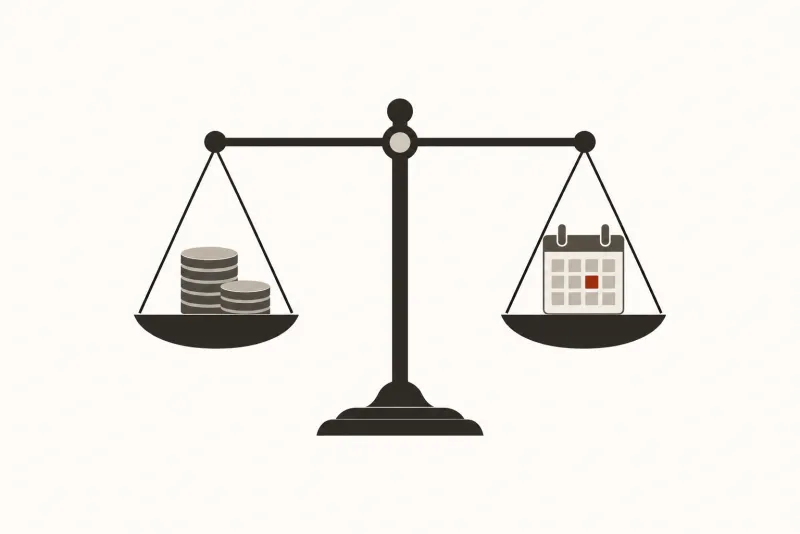
Facebook ads for med spas work when one priced offer, plain ads and a fast reply all lead to a booked consult. Hold one daily budget for four weeks, with a stopping rule. Judge ads on cost per booked consult, not cost per lead. In our made-up example, a $25 lead became a $167 patient, and that still paid.
This guide walks one clinic through each step instead of quoting benchmarks. Juniper Med Spa is a hypothetical clinic, made up for this guide. It has two injectors, one laser room, one front desk person and $1,500 a month for ad spend. Ryder Scale is not affiliated with Meta, Facebook or Instagram.
What offer should a med spa put in a Facebook ad?
Put one front-end offer in the ad, with the price shown. A front-end offer is the first thing a new patient buys, not your full menu.
Dana, Juniper's owner, first wanted an ad for "all our services." She chose better: a first underarm laser hair removal session at a set price. It filled the laser room's empty Tuesday and Wednesday afternoons. It passes three checks:
- A stranger understands it in one sentence.
- The price feels safe to say yes to.
- It leads to a series of sessions, which is where Juniper earns its money.
An ad cannot fix a weak offer. Our guide to building a med spa new patient offer covers how to choose and price one.
What creative works in Facebook ads for med spas?
Creative (the image or video plus the words) works best when it looks like your clinic and states the offer plainly. A 15-second phone video of your laser tech explaining the first session feels more real than a stock photo of a model.
Dana made three ads: the tech on camera, a room tour with the price on screen, and a patient (with written consent) saying why she booked. Each named the offer, the price and the next step: "Send us a message to pick a time."
Meta's health and beauty ad rules
Meta limits what these ads can say. Four rules matter most.
- Do not imply you know something about the viewer's health. Ads "must not contain content that asserts or implies personal attributes," including medical conditions. Meta allows "New diabetes treatment available" and rejects "Do you have diabetes?" (Meta Transparency Center, Personal Attributes policy, 2026).
- Do not attack how people look. Meta's Health and Wellness policy bans "statements of inferiority about physical appearance." That means putting down a person's looks, body or hygiene.
- Target adults only. Cosmetic procedure ads must target people 18 or older. Before-and-after images of general cosmetic procedures are allowed under that same rule (Meta Transparency Center, Health and Wellness policy, updated July 2026).
- Prescription drugs have their own policy. Selling semaglutide (a weight-loss shot)? Online clinics and online pharmacies need certification from LegitScript, an outside reviewer. Only then can they ask Meta to promote prescription drugs (Meta Transparency Center, Drugs and Pharmaceuticals policy, 2026).
In a headline, that looks like this:
- Rejection risk: "Tired of your wrinkles?" "Hate your double chin?" "Are you overweight?"
- Safer: "Lip filler consults now open in Austin." "First underarm laser session, $99, with our nurse team."
Who should see the ads, and where should the click go?
Show the ads to adults 18 and over who live close enough to drive to you. Dana set a radius that matched how far her current patients already drive. She did not narrow it by interests like "skincare." On a small budget, a narrow audience can make each view cost more.
Let the ads run in the Facebook and Instagram feeds and Reels (full-screen vertical videos). One vertical video and one square image can fill all four spots. Both apps reach a lot of people. 71% of US adults say they use Facebook, and half say they use Instagram (Pew Research Center, 2025).
The click can open a lead form inside the app, a page on your website, or a direct message (DM) with your clinic, through click-to-DM ads. A form needs your front desk to call back within minutes. A page needs a fast site with online booking. A DM needs someone answering at every hour the ad runs. Dana chose a DM, because her front desk was slow to call back and her offer was simple to explain in a chat. Our guide to Instagram ad destinations for med spas compares all three.
How much should a med spa spend on Facebook ads per day?
First decide the most you will pay for one booked consult. Then pick a daily amount you can keep up for four weeks.
Dana's $1,500 a month is $50 a day. Before launch, she worked out her limit:
- A new laser patient spends $900 at Juniper in the first year.
- After product, staff time and room cost, $540 of that is profit.
- Dana will spend one third of that profit to win a patient: $180.
- Half of her booked consults become paying patients. So her limit is $90 per booked consult.
Then she wrote a stopping rule:
- Any ad that spends $270 (three times her limit) with zero booked consults goes off.
- If cost per booked consult stays above $90 for two weeks, she fixes the offer or the creative before adding money.
Swap in your own numbers. To set the monthly number in the first place, see how much a med spa should spend on marketing. For a rough guide, the average med spa puts about 7% of its revenue into marketing (AmSpa, 2025).
What does a lead really cost a med spa?
A lead costs your ad spend divided by the number of inquiries. On its own, that number tells you little. Each later step loses people, so each one costs more.
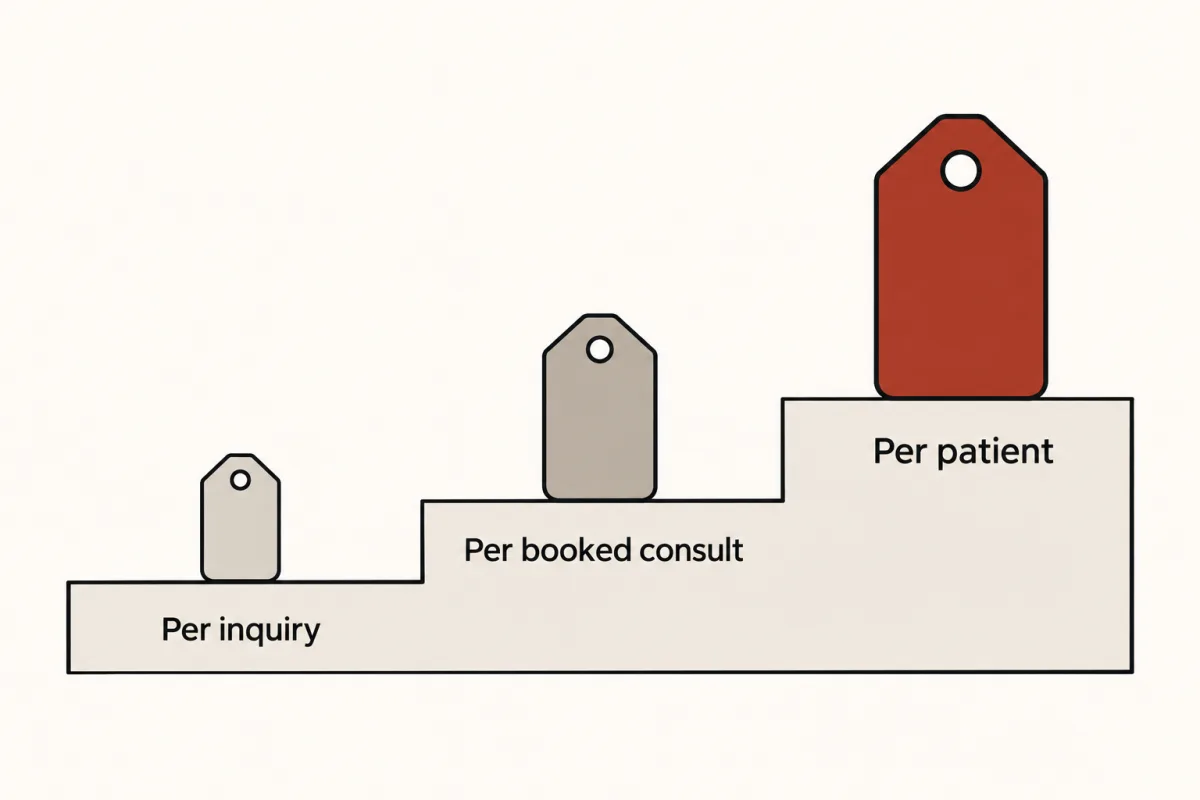
The table shows where Juniper's $1,500 went, from first message to paying patient. It is a hypothetical example.
| Step (hypothetical month, $1,500 ad spend) | Count | Ad spend divided by count |
|---|---|---|
| Inquiries (DMs started from the ad) | 60 | $25 per inquiry |
| Booked consults (time chosen, card on file) | 18 | $83 per booked consult |
| Attended consults | 14 | $107 per attended consult |
| New paying patients | 9 | $167 per new patient |
The new patient cost almost seven times the $25 inquiry. That is fine, because $83 sits under Dana's $90 limit and $167 sits under her $180 limit. The ads stay on.
The biggest drop, 60 inquiries to 18 bookings, is about the reply, not the ad. A faster, clearer reply can lower every number below it. One older study of phone calls to web leads found the odds of qualifying a lead dropped 21 times when the first call came at 30 minutes instead of 5 (InsideSales.com and MIT, 2007). Fix the reply first. Our med spa DM scripts cover the 20 questions people ask most.
Why published cost-per-lead benchmarks mislead
Benchmark posts mislead because "lead" means something different in each one. One counts a form fill. Another counts a DM that said "hi." A $30 lead for a $99 facial is not the same deal as a $30 lead for hair restoration. The only number that counts is your own limit, based on your profit per patient, like Dana's $90. Work out yours instead.
How to review med spa Facebook ads each week
Review once a week, on the same day, with the same numbers.
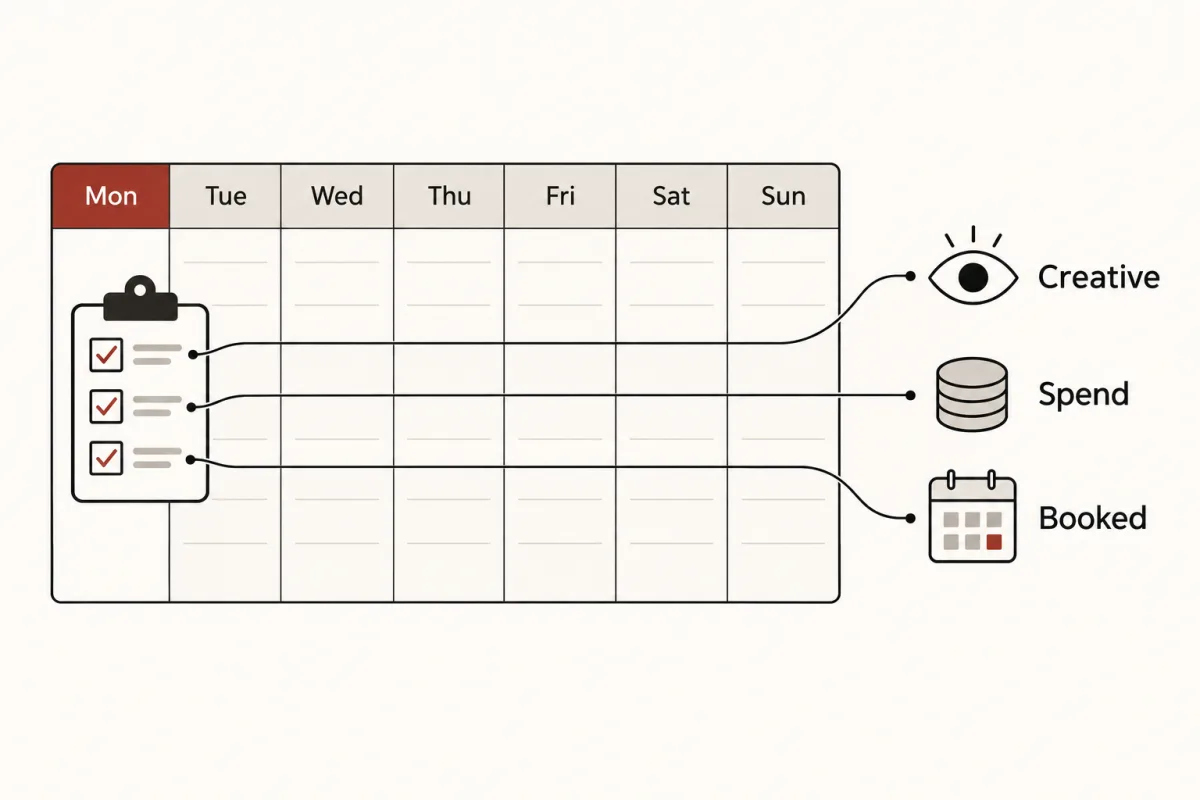
- Write down spend, inquiries, booked consults, attended consults and new paying patients for the last 7 days.
- Work out cost per booked consult and per new patient. Compare both with your limits.
- Turn off any ad that hit your stopping rule.
- Check frequency (how many times each person saw the ad, on average). If it climbs while bookings drop, add a new video.
- Read ten DM threads that did not book. Note the question that stalled each one.
- Change one thing: a new ad, a better answer to that stalled question, or the offer. Write it down.
Frequently asked questions
What is the average cost per lead for med spa Facebook ads?
No average is worth trusting. Each source defines a lead its own way, with its own offer and city. Work out your own limit instead. Take the profit from a new patient's first year. Decide what share you will spend to win one. Then multiply by the share of booked consults that become patients.
Should a med spa run Facebook ads or Instagram ads?
Both, from one campaign. You buy both in the same Meta tool, and one campaign can show in both feeds and both Reels spots. Let Meta move money to the spots where people respond. Then check which spot produced booked consults.
Can a med spa use before-and-after photos in Facebook ads?
Yes, with limits. Meta's Health and Wellness policy allows before-and-after images of general cosmetic procedures when the ad targets people 18 or older. The ad still cannot attack how someone looks or imply it knows about the viewer's health. Get written consent from every patient shown, and check your state's rules with your attorney.
How long until I know if Facebook ads work for my clinic?
Give a new campaign four weeks at a steady daily budget before you judge it. By week four you have enough booked consults to compare against your limit. Your stopping rule switches off a losing ad early, so you never wait blind.
These numbers only work if each booking carries a source tag (a note of which ad it came from). Our guide to tracking med spa marketing ROI (return on investment) shows how to set one up. Ryder Scale runs Facebook and Instagram ads for one offer per clinic, with no retainer. You pay per qualified booked consult. Book a free 20-minute audit to see whether that fits your clinic.