How much should a med spa spend on marketing? Spend what it takes to fill the appointment slots you can actually serve. Cap that spend at a share of what each new patient contributes after the cost of treating them. That gives you a number built from your own clinic, not a percentage of revenue copied from someone else's business.
To run your own numbers, use our free med spa marketing cost calculator. It shows your cost per lead, per booked consult and per new patient.
A revenue percentage tells you what other clinics chose to spend. The average med spa puts about 7% of its revenue into marketing (AmSpa, 2025). It does not tell you whether you have room for new patients, or whether each one pays back the ad that found them. Four inputs from your own records answer how much should a med spa spend on marketing better than any percentage does.
Why a revenue percentage is the wrong starting point
A percentage of revenue ignores the two things that decide whether marketing pays: spare capacity and contribution per patient. Picture two clinics with the same revenue. One has a full book and a waitlist. The other just hired a second injector and has 15 empty slots a week. The second clinic should spend more, even if it earns less today.
Contribution is the money left from a new patient's first visit after you pay for product, provider time and supplies. It is not revenue. A $600 treatment with $250 of delivery cost contributes $350. Marketing has to be paid out of that $350, not the $600.
The four inputs that set a med spa marketing budget
Four numbers set the budget. Pull them from your own records.
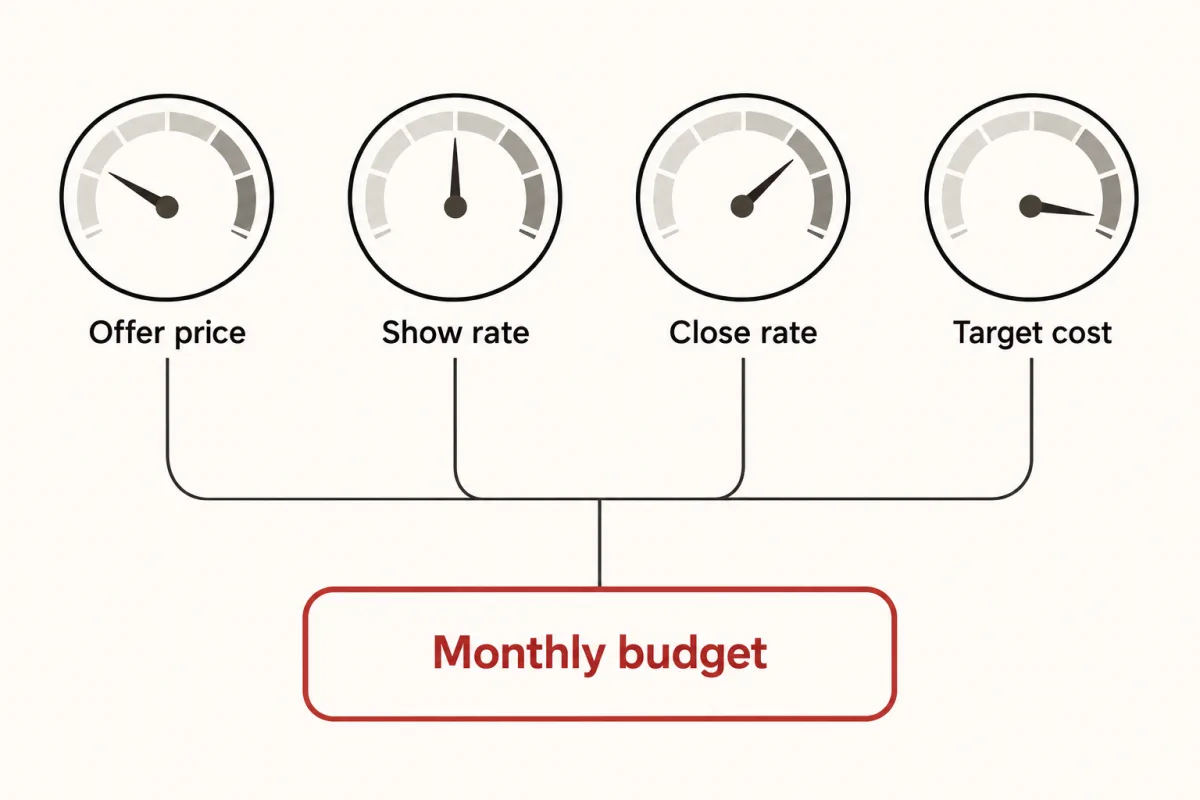
- Open appointment slots per week. Count the slots you could give to new patients without pushing existing patients out.
- Contribution per new patient. Take the price of the front-end offer you plan to run. Subtract product, provider time and supplies. If most patients come back, you can add the second visit too, but write that assumption down. For scale, the average patient spends $527 per visit (AmSpa, 2024).
- Consult-to-patient rate. Of the people who book a consult for this offer, how many end up buying? Count no-shows as booked consults that did not buy, because you paid to book them. If you have no history, pick a cautious guess.
- Test length. Decide how many weeks you will run before judging. Four to six weeks gives most clinics enough booked consults to see a pattern.
A med spa marketing budget worksheet
Fill in the rows in order, and the last row is your monthly ceiling. The example column is a hypothetical example, not a benchmark or a client result.
| Line | How to get it | Hypothetical example |
|---|---|---|
| 1. Open new-patient slots per week | Count them in your booking system | 10 |
| 2. Slots to fill per month | Line 1 x 4 | 40 |
| 3. Consult-to-patient rate | Your records, or a cautious guess | 50% |
| 4. Booked consults needed per month | Line 2 / Line 3 | 80 |
| 5. Contribution per new patient | Offer price minus delivery cost | $350 |
| 6. Share of contribution you will spend to win a patient | Your choice. Higher buys growth, lower protects profit | 40% |
| 7. Allowable cost per new patient | Line 5 x Line 6 | $140 |
| 8. Allowable cost per booked consult | Line 7 x Line 3 | $70 |
| 9. Monthly budget ceiling | Line 4 x Line 8 | $5,600 |
Line 8 is the number to watch during the test.
How much should a med spa spend on marketing per month: a hypothetical example
In this hypothetical example, the ceiling is $5,600 a month. Here is the arithmetic.
One provider has 10 open slots a week, so 40 a month. Half of booked consults become paying patients, so filling 40 slots takes 80 consults. The offer sells for $600 and costs $250 to deliver, so each new patient contributes $350. The owner will spend up to 40% of that to win a patient, which is $140. Since only half of consults convert, that is $70 per booked consult. 80 consults x $70 = $5,600.
Spend more than that, and new patients stop paying for themselves on the first visit. Starting at the ceiling is not required. The clinic could begin at about half, measure its real cost per booked consult, and move up if the number holds. These figures are a hypothetical example. They are not Ryder Scale client results and they do not predict your campaign.
Where the money goes in med spa advertising cost
Med spa advertising cost splits into five buckets: media, creative, management, booking handling and software. Ask any provider to show you all five, because a low fee in one bucket often hides a high one in another.
- Media. The money paid to Meta to show your Instagram and Facebook ads. In our arrangement the clinic pays Meta directly.
- Creative. Writing, filming and editing the ads.
- Management. Setting up the campaign, testing audiences and adjusting spend. Billed as a retainer, a percentage of media, or folded into a per-result fee.
- Booking handling. Replying to inquiries and turning them into appointments. Your front desk, a call center or an AI assistant.
- Software. Scheduling, messaging and reporting tools.
Pricing models move cost between buckets rather than removing it. A retainer charges for management whether or not consults get booked. A pay-per-result model charges only when a defined result happens, so the definition matters more than the price. Our comparison of pay-per-lead and pay-per-booked-consult pricing explains what each model bills for.
When to stop, hold or scale the budget
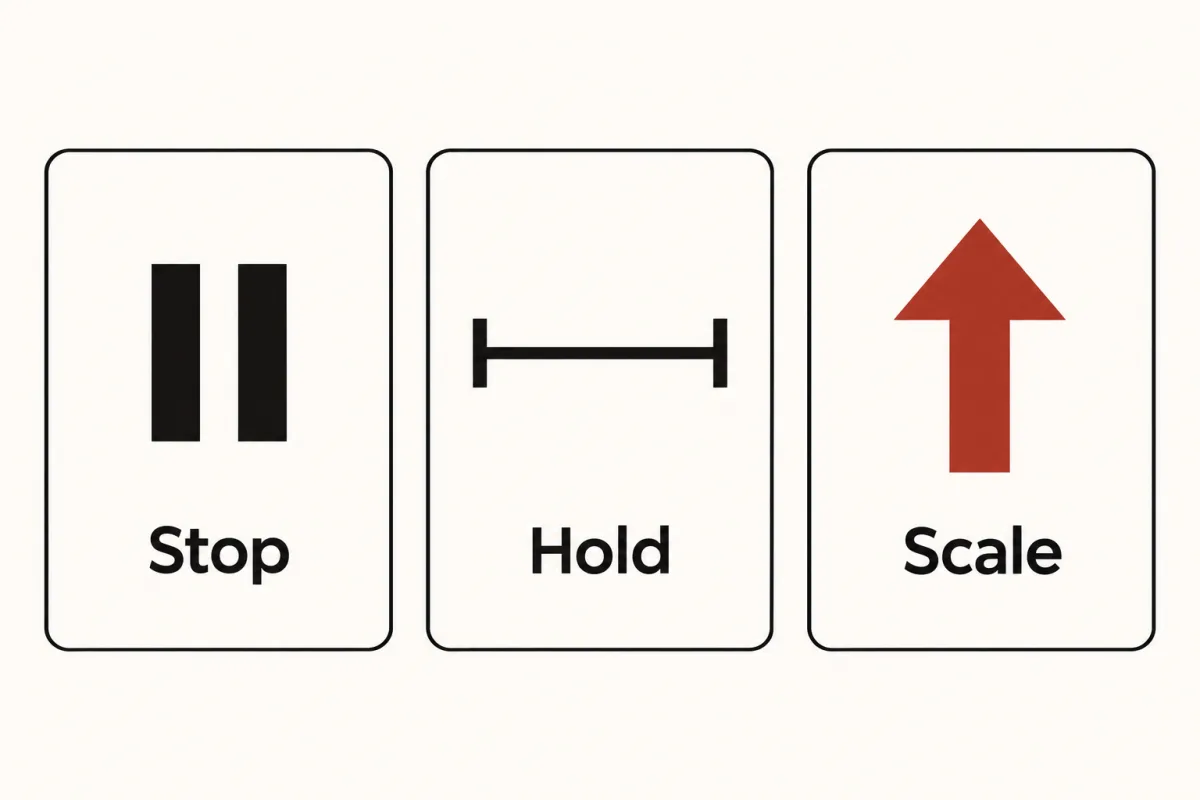
Scale when your real cost per booked consult sits under line 8 and you still have open slots. Hold when it matches line 8. Stop and fix when it runs over for two weeks in a row, or when your slots are full.
Review on the same day each week:
- Compare cost per booked consult with line 8.
- Compare attendance and purchase rates with the rate you assumed in line 3.
- Count open slots. A full book means the limit is now capacity, and more ad spend will not help.
- Decide to scale, hold or stop, and write down why.
The answer to how much should a med spa spend on marketing is not fixed. It changes as slots fill and real costs come in. If cost runs over the ceiling, the fault sits in the offer, the ad or the booking step. Fixing one of those is cheaper than adding spend. A slow reply is a common leak in the booking step. In one study, the odds of qualifying a web lead dropped 21 times when the first call came at 30 minutes instead of 5 (InsideSales.com and MIT, 2007). That study looked at phone calls, but a slow reply to a DM wastes ad spend the same way. Our guide to tracking med spa marketing ROI shows how to keep each stage separate so you can see which one broke.
Questions to ask a provider about budget
Ask the provider to tie its fee to your worksheet, not to a package.
- What result triggers a fee, and how is it defined in writing?
- Who pays Meta for media, and does that money pass through the agency?
- Is there a minimum monthly spend or contract length?
- How will you report cost per booked consult against the ceiling we set?
- What happens to the budget when our slots fill up?
A provider that cannot answer the first question in one sentence is selling a package, not a result. Our agency selection checklist covers the rest.
Frequently asked questions
Should a new med spa spend more on marketing than an established one?
Spend depends on open capacity and contribution per patient, not on the clinic's age. A new clinic has more empty slots, so the worksheet gives it a higher ceiling. It also has no history for the consult-to-patient rate, so it should start well under the ceiling and let real bookings replace the guess.
Is there a minimum med spa marketing budget for Instagram and Facebook ads?
The minimum is the amount that buys enough booked consults to judge the campaign. A test that produces five bookings tells you nothing, because one no-show changes the whole picture. Run the worksheet, pick a test length, and set the spend so a few dozen booked consults land inside the test window.
What if I do not know my consult-to-patient rate?
Pick a cautious figure, label it as a guess, and run the first test on it. A lower guess produces a lower ceiling, which protects you while the data comes in. After four to six weeks, replace the guess with the real rate from your booking system and recalculate the ceiling before you scale.
How much should a med spa spend on marketing comes down to two numbers you already own: open slots and margin per patient. Set the budget from those, then write it into a plan you can measure. Our med spa marketing plan guide shows where the budget fits beside the offer, the ad and the booking step. Ryder Scale runs Instagram and Facebook ads for one front-end offer per clinic. An AI receptionist books consults from those ad conversations only, and the clinic pays Meta directly for media. There is no retainer and you pay per qualified booked consult, so book a free 20-minute audit to run the worksheet on your own numbers.