
A med spa marketing agency cost is three bills, not one: the agency fee, the ad spend you pay Meta, and any software or creative. The fee comes as a monthly retainer, a share of ad spend, or a charge per result. Compare quotes on total cost per booked consult, not on the headline fee.
To run your own numbers, use our free med spa marketing cost calculator. It shows your cost per lead, per booked consult and per new patient.
Quotes rarely show all three bills side by side. Below, one made-up clinic goes from two quotes to a decision. Swap in your own numbers.
What makes up a med spa marketing agency cost?
Every quote has three parts, even when it shows one number.
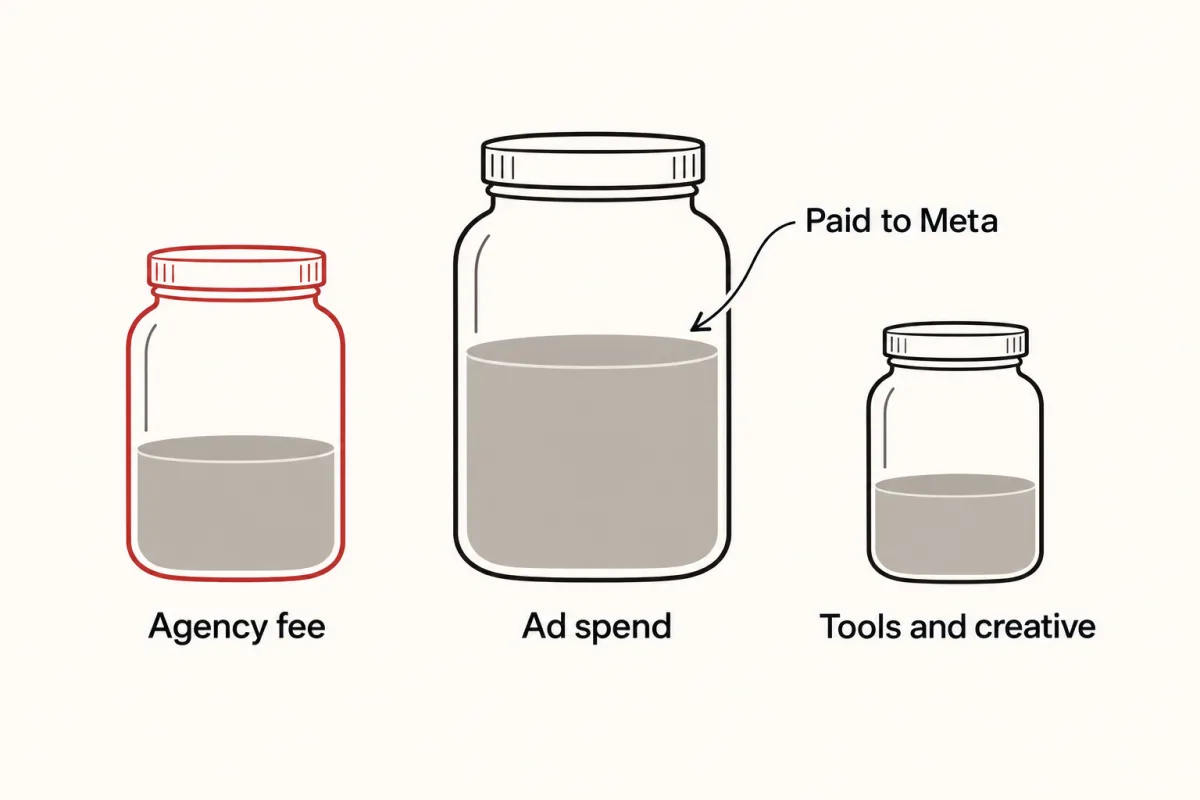
- Agency fee. What the agency keeps for planning, running and fixing the campaign.
- Ad spend. What Meta charges to show your ads on Instagram and Facebook. Some agencies pay Meta for you and bill you back with a markup (an extra charge on top of cost).
- Software and creative. Chat tools, call tracking, and creative (the images, videos and words in each ad). Some quotes include these. Others bill them extra.
Only the first bill pays the agency. So a low fee can still mean a high cost per new patient. All three bills come out of one budget, and the average med spa puts about 7% of its revenue into marketing (AmSpa, 2025). For ad budgets, see our guide on how much a med spa should spend on marketing.
Meet Maple Street Med Spa, a made-up clinic with two injectors and one front desk. Quote A says $2,500 a month. Quote B says no monthly fee, only a charge per booked consult. Neither headline is the full cost.
How do med spa marketing agencies charge?
Agencies charge a retainer, a share of ad spend, or a fee per result. The table shows what each model charges for, what you pay when nothing books, and who takes the loss.
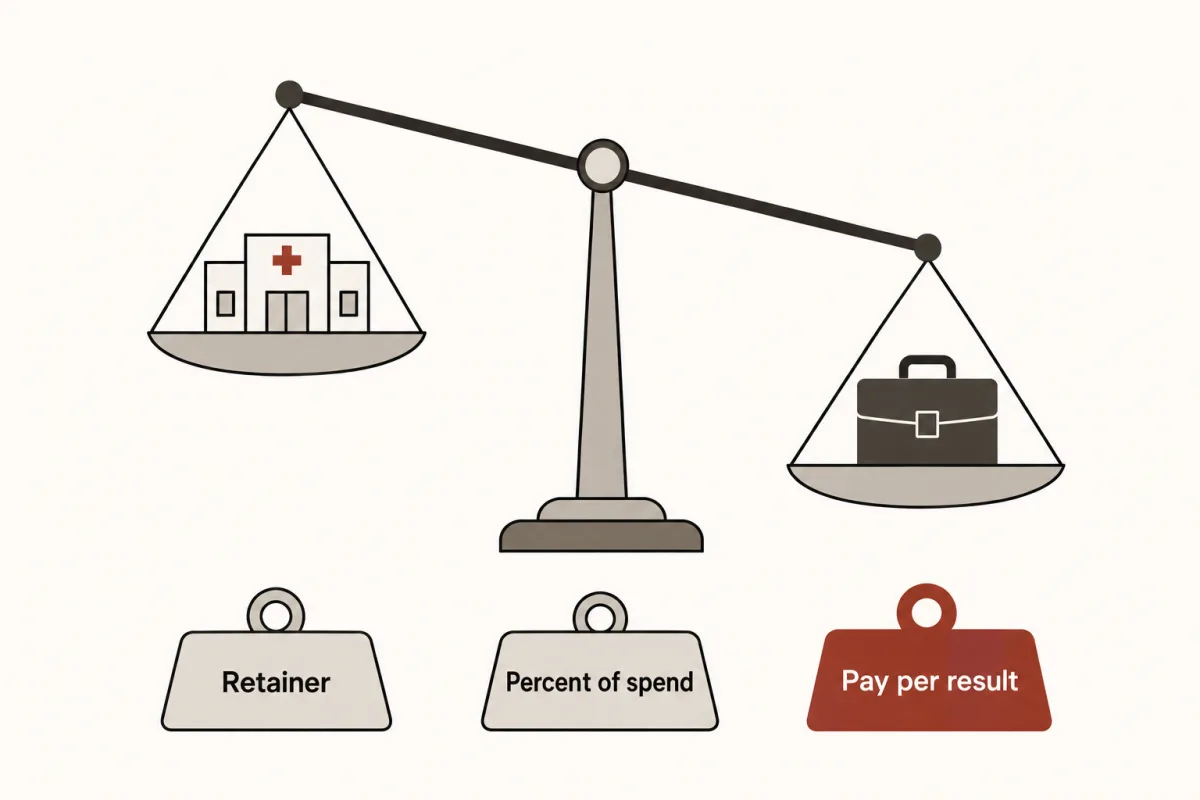
| Model | What you pay for | What you pay if nothing books | Who carries the risk | Best fit |
|---|---|---|---|---|
| Monthly retainer | The agency's time | Full fee, ad spend and software | You | Clinics that want a fixed bill |
| Percentage of ad spend | A share of your Meta budget | Fee on what was spent, plus ad spend | You | Clinics with a large, steady budget |
| Pay per lead | Each name or message | Ad spend, plus fees for leads that never book | Mostly you | Clinics that call every lead back in minutes |
| Pay per booked consult | Each date and time booked to your rules | Ad spend only | Shared: the agency loses its fee, you lose the ad spend | Clinics that want to pay only for bookings |
A retainer is a fixed fee paid every month, whether 2 people book or 40. The agency earns the same in a bad month as a good one. Ask what they change after a slow month.
A percentage of ad spend grows with your budget, even if bookings do not. Ask about any monthly minimum.
With pay per result, the definition matters more than the price. A lead is a name or a message. A booked consult is a date and time on your calendar. Our comparison of pay per lead vs pay per booked consult explains the gap. A lead also goes cold fast. In one study, the odds of reaching a web lead fell by over 10 times within the first hour (InsideSales.com and MIT, 2007). That study looked at phone calls, but the same idea applies to DMs.
No model removes ad spend risk. Meta charges whether or not anyone books. Set a monthly ad budget you could lose without pain.
What hidden costs should I check in an agency quote?
The hidden costs sit in the contract, not the headline price.
- Setup fee. A one-time charge to build the account, ads and tracking.
- Creative fees. Ask how many new ads each month the fee covers.
- Minimum term. A 6-month minimum on a $2,500 retainer is a $15,000 promise before the first ad runs.
- Cancellation notice. A 30-day notice adds a month of fees after you stop.
- Software passthrough. Tools billed to you. Ask for each price and any markup.
- Ad spend handling. Do you pay Meta on your own card, or does the agency pay and bill you?
- Ad account and pixel ownership. The pixel is a piece of Meta tracking code that records what people do after they see your ad. If the agency owns them, your ad history leaves with the agency.
Here are Maple Street's full quotes. These are made-up numbers, not market rates, and Quote B is not Ryder Scale's price.
- Quote A: $2,500 a month retainer, $1,500 setup, $300 a month for software, 6-month minimum, $3,000 a month to Meta.
- Quote B: no retainer, no setup fee, $150 per booked consult, cancel any month, the same $3,000 a month to Meta.
How do I compare two quotes on cost per booked consult?
Divide your total monthly cost by the consults booked that month. Total cost means all three bills. Use one booking definition for every quote.
- Add every monthly cost: agency fee, ad spend, software, and the setup fee divided by the months in the minimum term.
- Put the same ad spend in every quote, so you compare the agency and not the budget.
- Pick one expected booking count and divide the total by it.
- Run it again for a slow month and a busy month. Read the slow month first.
- Find the break-even point: the booking count where both quotes cost the same.
In this made-up math, the booking counts are the owner's guesses, not promises.
Normal month, 20 booked consults. Quote A is $2,500 plus $300 plus $3,000 plus $250 of setup ($1,500 over 6 months). That is $6,050, about $303 per consult. Quote B is $3,000 plus 20 times $150, so $6,000, or $300 per consult.
Slow month, 10 booked consults. Quote A still costs $6,050, so $605 per consult. Quote B costs $4,500, or $450 per consult.
Busy month, 30 booked consults. Quote A costs $6,050, about $202 per consult. Quote B costs $7,500, or $250 per consult.
Break-even. Set aside the $3,000 for Meta, which both quotes pay. Divide Quote A's $3,050 in fixed costs by Quote B's $150 per consult. You get about 20. At 20 or fewer booked consults a month, Quote B costs less. At 21 or more, Quote A wins.
Neither quote wins every month. The choice depends on how much cash you can lose in a slow month. Maple Street has never run ads. So its owner picks Quote B to limit what a bad month can cost. Either way, count bookings in your own booking system, not the agency's report.
What should I ask a med spa marketing agency before I sign?
Ask questions that put each fee into a written definition.
- What is my total monthly cost at my planned ad spend, with every fee included?
- What do I pay in a month when nothing books?
- Who owns the ad account, the pixel and the ads if I leave?
- Does your report show booked consults by source?
Our guide to choosing a med spa marketing agency covers offer, fit and team.
How does Ryder Scale price its work?
Our med spa marketing agency service charges per qualified booked consult, with no monthly retainer and no setup fee. A qualified booked consult is a date and time chosen with a card on file. That is a booking definition, not a promise that the person attends, buys or is a clinical fit. You pay Meta directly for ad spend. So in a slow month, you still pay Meta.
We run Instagram and Facebook ads for one front-end offer per clinic (the first thing a new patient books). The ad opens a DM. Meta says 1 billion people message a business each week on its apps (Meta for Business, 2026). An AI receptionist replies only to DMs from those ads. It answers questions about the offer and asks simple fit questions that are not medical. It offers times and takes a card on file to hold the slot. Then it writes the consult into Boulevard, Zenoti, Vagaro, Mindbody, Aesthetic Record or Square. Anything else goes to your team. We have no published case studies, so we do not quote results. Ryder Scale is not affiliated with Meta, Facebook or Instagram.
Frequently asked questions
How much do med spa marketing agencies charge per month?
It depends on the fee model: a fixed retainer, a share of ad spend, or a charge per result, such as a booked consult. You also pay Meta for ad spend. Ask for every quote split into agency fee, ad spend and software.
Is ad spend included in the agency fee?
Do not assume it is. Ask for both numbers on separate lines of the quote. If the agency pays Meta for you, ask to see the Meta invoice each month. That is how you spot a hidden markup.
Is pay per booked consult always cheaper than a retainer?
No. In a busy month, a fixed retainer can cost less per consult. In a slow month, pay per booked consult costs less. The real difference is risk. With a retainer, you pay the fee whatever happens. With pay per booked consult, the agency earns only when consults book. Run your slow-month math before you pick.
Who should own the Meta ad account and pixel?
Your clinic should. The ad account holds your ad history. The pixel holds what Meta has learned about the people who respond to your ads. If the agency owns both and you leave, you start from zero. Ask for both in your clinic's name, with the agency added as a partner.
After you sign, check cost per booked consult monthly. Our guide to tracking med spa marketing ROI (return on investment) shows how to pull it from your booking system. To see whether pay per qualified booked consult fits your clinic, book a free 20-minute audit.