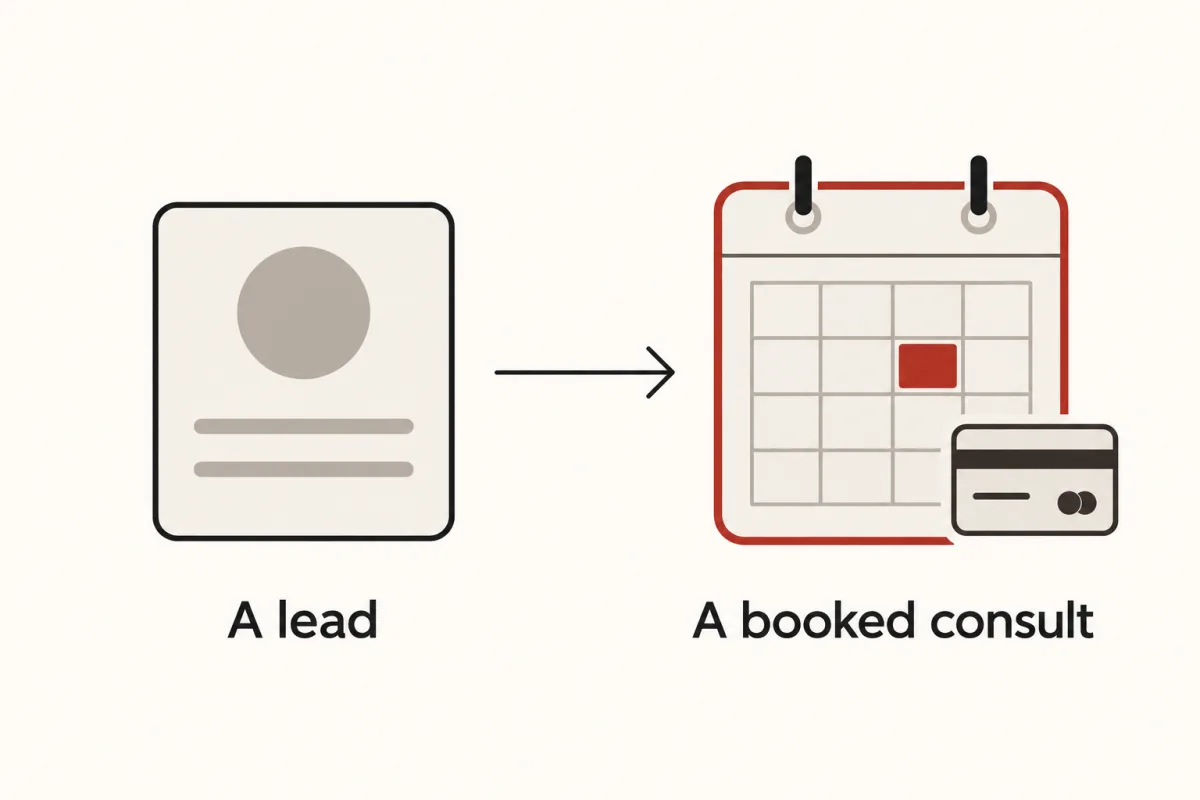
Med spa lead generation should be judged by consults, not leads. A lead is a name, a phone number or a message. A consult is a date and time in your calendar. Pay for the second one when you can. If you pay for the first, decide now who turns each lead into a booking, and how fast.
You want new patients. Most providers sell you leads by the month. This guide covers the gap and what to ask before you sign.
What is the difference between a lead and a consult?
A lead is someone who raised a hand. A consult is someone who picked a time. Every step between the two is work. With bought leads, your front desk does that work while also checking in patients and answering the phone.
In this hypothetical example, a clinic buys 60 leads for $1,800. That is $30 a lead, which sounds cheap. The front desk calls 41 the same day, reaches 22 and books 9. Six show up and 3 pay for a treatment. So the same $1,800 is $200 per booked consult and $600 per new patient. Run this math on last month's leads.
What should a med spa pay for: leads or booked consults?
Pay for the last step the provider is in charge of. If it only runs ads, paying per lead is fair. If it also answers and books, ask to pay per booked consult. The table shows each step from lead to paying patient.
| Stage | What it is | Who controls it | What to count |
|---|---|---|---|
| Lead | A name, phone number, email or DM thread | The ad and the offer | Leads by source |
| Qualified booked consult | A date and time chosen, with a card on file, after a few fit questions | Whoever answers the lead | Booked consults by source |
| Attended consult | The person walked in at the booked time | Your reminders and your card policy | Shows and no-shows |
| New patient | The person paid for a treatment | Your provider in the room | New paying patients |
Each row has fewer people than the last, but each is worth more. If a provider charges for leads, your front desk still does rows two to four. A card on file means the person gave card details to hold the slot. A booked consult is a booking, not a promise that the person attends, buys or is a clinical fit.
Our guide to pay per lead vs pay per booked consult walks through the math of both models.
Where do med spa leads come from?
A small med spa gets new patients from four sources. Each hands your team a different amount of work.
- Paid social (Instagram and Facebook ads). Reaches people who were not looking for you. Hands you a form fill, a website visit or a direct message (DM). Meta says 1 billion people message a business each week on its apps (Meta for Business, 2026). The first reply matters most. Our med spa DM scripts show what to say.
- Google (search ads and your Google Business Profile, your free Maps listing). Reaches people already searching. Hands you a call, a booking click or a web form.
- Referrals. Hands you a friend's name and a reason to trust you. They cost no ad spend. Volume depends on how often your team asks.
- Existing patients. Hands you a rebooking. Count these apart, or they can hide a slow month for new patients.
Paid social and Google grow with spend. Half of US adults say they use Instagram, and 71% say they use Facebook (Pew Research Center, 2025). Referrals grow when you ask, so ask every happy patient for a referral.
Why do leads stall before they book?
Leads stall for four reasons. Each one is a clinic problem, not an ad problem.
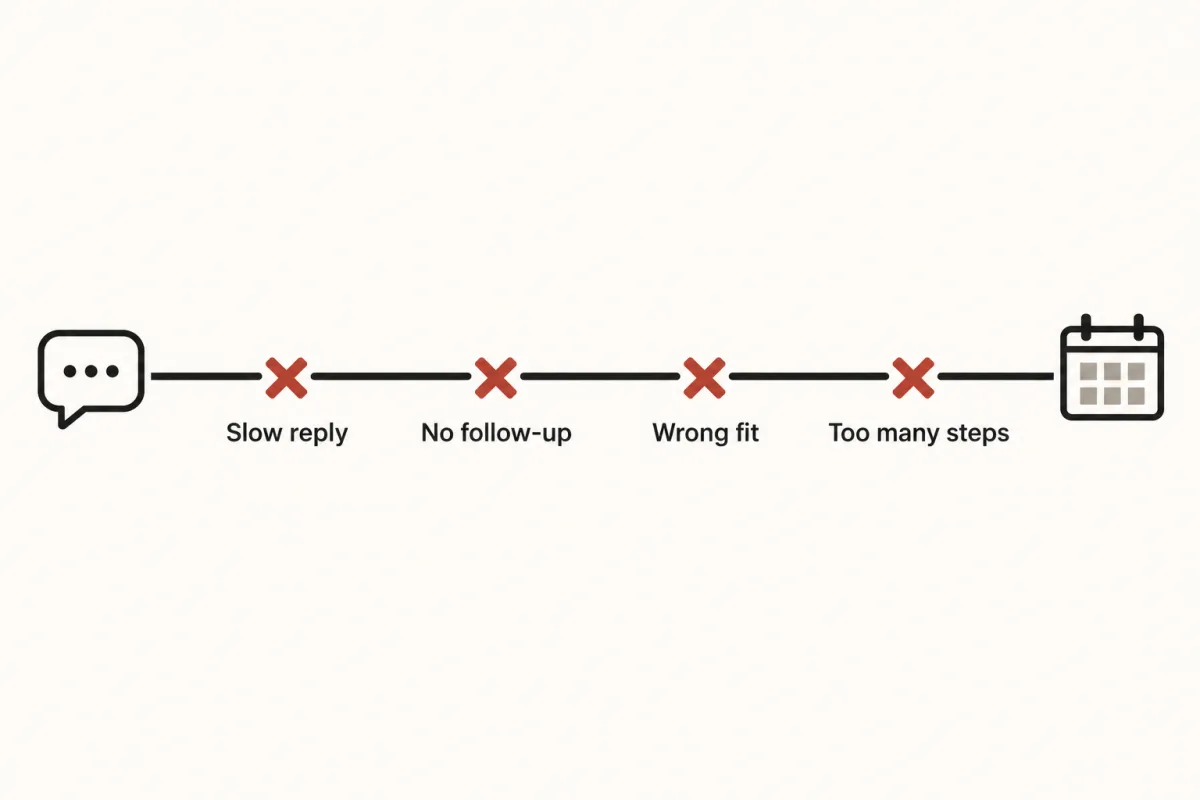
- Speed. A person fills in a form at 8pm. If the call comes at 11am the next day, they have forgotten which clinic it was.
- Follow-up. Many people miss the first call. A busy front desk stops after one try.
- Qualification. Qualifying questions are simple, non-clinical checks that the person fits the offer. Do they live nearby? Do they know the price?
- Friction. Friction is every extra step between "I'm interested" and "I'm booked." "Call us to schedule" is a step that loses people. The shortest path ends with a time picked inside the same conversation.
Fix speed first. Nobody reports the leads that went cold overnight. In one study that measured phone calls to web form leads, the odds of reaching a lead were 100 times higher when the call came within 5 minutes instead of 30 (InsideSales.com and MIT, 2007).
Who covers the follow-up window?
The follow-up window is the time between a lead arriving and the first real reply. One named person or tool has to own it for every hour your ads run. Ads run at 9pm on a Sunday. Your front desk does not.
The front desk knows the clinic but works clinic hours. A virtual assistant (a remote worker who covers the inbox for set hours) needs training. An AI receptionist replies at any hour but needs approved answers and a rule for handing off to a person. Whoever it is, write the plan down:
- Reply to every new lead within five minutes during covered hours.
- Try again the same day by a different route, such as a text after a call.
- Try a third time the next morning.
- After three tries with no reply, mark the lead cold and stop.
If nobody covers evenings and weekends, pause ads at those hours. Our guide to click-to-DM ads for med spas covers who should answer those messages and how fast.
How to judge med spa lead generation services
Ask any med spa lead generation agency four questions, and get the answers in writing.
- What do you hand over? A spreadsheet of names, a DM thread, or a consult already in your booking system.
- Who follows up? If the answer is "your team," you are buying a to-do list. If it is the provider, ask to read real conversations.
- What triggers the fee? A click, a form fill, a "qualified" lead or a booked time. Ask for the exact definition of qualified.
- Who owns the ad account? You want to keep the ads and their history if you part ways.
Here is how Ryder Scale works with clinics, so you can check us against those four questions. We create and run Instagram and Facebook ads for one front-end offer per clinic (the first offer a new patient sees). The ad opens a DM, not a landing page. An AI receptionist replies only to DMs from those ads. It answers questions about that offer and asks non-clinical qualifying questions. Then it offers open times and takes a card on file to hold the slot. It writes the consult into your booking system (Boulevard, Zenoti, Vagaro, Mindbody, Aesthetic Record or Square). Anything else goes to your team, and the rest of your inbox is untouched. Clinical decisions stay with your providers.
The fee triggers on a qualified booked consult: a date and time chosen with a card on file. There is no retainer (a fixed monthly fee) and no setup fee. You pay Meta (owner of Instagram and Facebook) directly for ad spend.
A weekly lead scorecard for your med spa
A scorecard is a short list of counts you fill in every Monday, by source. Make "how did you hear about us" a required field in your booking software.
- Leads in: calls, forms and DMs.
- Replied within five minutes: your coverage score.
- Qualified booked consults: a time chosen, with a card on file.
- Attended consults: who walked in, from your booking system.
- New patients: who paid for a treatment.
- Spend: ad spend plus any provider fees.
- Cost per booked consult: spend divided by booked consults.
Divide each row by the one above it. The lowest result is your leak, where you lose the most people. In a hypothetical week, a clinic gets 40 leads, replies fast to 15 and books 6. The leak is speed, not the ads.
Our guide to tracking med spa marketing ROI (return on investment) turns these counts into cost per new patient.
Frequently asked questions
What is the difference between a lead and a booked consult?
A lead is contact details or an open conversation. A booked consult is a date and time the person chose, held in your calendar. The lead still needs someone to reach the person, answer questions and offer times. The booked consult has already been through those steps. Paying per booked consult moves that work, and that risk, to the provider.
How many leads does a med spa need each month?
Work backward from the number of new patients you want. If you want eight new patients and two of every three booked consults become patients, you need twelve booked consults. Then use your booking rate: the share of your leads that book. If one lead in four books, you need 48 leads.
Are cheap leads a good deal?
Only if they turn into consults. A low price per lead can hide a high price per new patient. If many numbers are wrong or the people never meant to book, your front desk does the sorting for free. Compare providers on cost per booked consult from your own booking records, not on cost per lead.
Is a med spa lead generation agency worth it?
It depends on your team's time and on what the agency hands over. An agency that sends names helps only if your front desk can call them within minutes. An agency that books consults helps when your team is too busy to chase leads. Compare the cost per booked consult in both cases, not the cost per lead.
To see where lead generation fits with your other channels, read our guide to med spa marketing strategies that lead to booked consults. Ryder Scale charges no retainer. You pay only per qualified booked consult. To see if that fits your clinic, book a free 20-minute audit.